

One of my favorite things about summer nights is spotting bats against the evening sky. Although people often give them a bad rap, bats are helpful and important parts of the natural world. They also make up a large and diverse group of animals that live a variety of lifestyles. Let’s get to know these incredible animals, and check out 18 amazing facts about bats.
Whether you’re looking for bat trivia or to better understand these fascinating creatures, this blog post will give you a taste for these ancient and impressive critters. I scoured the internet, my own natural history library, and chatted with fellow biologists to bring together the coolest facts about bats that I can find. Enjoy!
1. They’re all closely related.
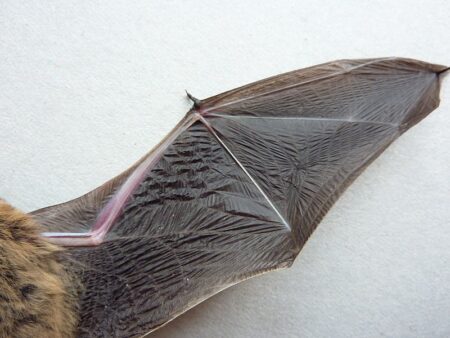

All bat species are related to one another. In other words, they all came from the same common ancestor. Despite the many different shapes, sizes, colors, and lifestyles of bats (see below!), they are all one order. You can think of this kind of like a big family tree for individual species. If you’d like to learn more about terms like order, species, and family, check out my beginner guide to taxonomy.
Bats belong to the order chiroptera, which literally means “hand-wings”. Get it? A close look at a bat’s wing makes this pretty obvious. The fingers and thumb or digits of a bats “hand” are elongated to make a frame for their wing. These parts, as well as parts of the arm or forelimb are connected by a thin but durable membrane of skin. Scientists call this the patagium. With their lightweight skeletons and excellent hand-wings, bats have mastered the skies! As we’ll find out, this is quite a unique feat.
2. Bats are the only mammals capable of actually flying!

That’s right! Although all different orders of insects and most birds can fly, only mammals in the order chiroptera, the bats, can do so. Confused? The key here is the difference between flying, which scientists often call powered flight, and gliding.
Many other mammals are capable of gliding, which is a passive way of moving through the air in a forward direction. Some examples include:
- Flying squirrels (Pteromyini) in Eurasia and North America
- Flying possums (Petauridae) in Australia and Southeast Asia. Not to be confused with the North American opossum!
- Colugos (family Cynocephalidae), the bizarre “flying lemurs” of South Asia
- Anomalures or scaly-tailed squirrels (Anomaluridae) of Africa
Gliders must catch an updraft of wind, or leap from a tall height to cover distance. They cannot flap, or in any way power their own movement through the air.
By contrast, bats flap their wings and have special musculature to do so. They can sustain their flight beyond the momentum of a single “bound”. This is great, because they don’t jump particularly well! No other mammal can actually fly in this way.
3. There are over 1,400 species of bats.

The single order chiroptera that includes all bats is huge! It contains more than 1,400 species divided among 17 families. That’s more than one fifth of the estimated 6,400 mammal species on Earth! In fact, the only more species-rich (or as scientists call it, speciose) mammal order are the rodents.
Read on to learn more about some of the outstanding bat species in this group!
4. Bats are ancient mammals.
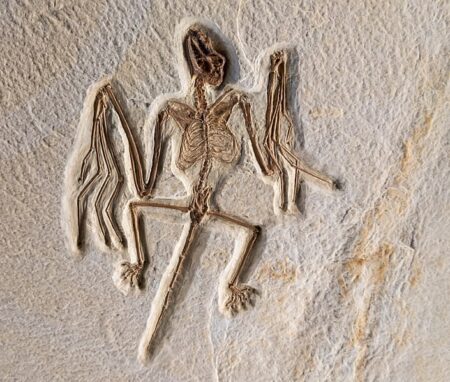
Bats have had a long time to split into all of those species. The oldest skeletal remnants of bats are more than 50 million years old! Interestingly, these bats were still very dependent on their eyes for hunting. Unlike most modern-day bats, they did not use echolocation to find their prey. They also still had claws on all of their fingers! Ancient bats weren’t tiny, either; the ancient bat Onychonycteris was probably 10 inches (~27cm) from head to toe, with a wing span of more than a foot!
5. They have been at evolutionary “war” with moths for 50 million years.

How’s that for a seriously hardcore fact about bats? As far as scientists understand, bats have been preying on flying insects for as long as there have been bats. Because many moths fly at night, the time when bats are hunting, they are high on the menu.
With their excellent hearing and echolocation capabilities, insect-eating bats can find flying and some perched moths in a snap. That’s bad news for moths, but they have their own strategies for defense. For example, some moth species’ hearing organs are “tuned” to the bats’ hypersonic echolocation sounds. Furthermore, when they hear a bat’s attacking sound, they can execute a rapid escape maneuver to drop and dodge the bat!

Even if moths hear a bat at a distance that isn’t attacking, they will still steer their flight to avoid it. Tiger moths (family Arctiidae) take this a step further. Specifically, they can produce their own hypersonic sounds, effectively jamming bat’s sonar to confuse incoming bats as to their location. To make things weirder, they produce these sounds from around their butts!
6. Bats eat many different foods—and “sucking” blood is not high on the list!

Although we often think of bats as vampiric monsters, the vast majority of them do not suck blood. Of course, even if only 3 of more 1,400 bat species take blood meals, the idea is scary enough to draw our attention. However, even those three vampire bat species aren’t very scary. Rather than suck blood like a vampire, they make a small cut, usually around the foot or ankle of a larger mammal. Typically, they bite cows, sheep, and other livestock. They only take a small amount of blood, and certainly don’t kill their victims!
In contrast to vampire bats, the other 99.9% of bats eat a whole variety of interesting foods. These include:
- Insects. The vast majority of bats are bug-eaters, making them fantastic pest control. Yes, this even includes eating mosquitoes!
- Fruit. Many bats, especially in the tropics, are fruit-eaters! These vegetarians gobble down dozens of juicy fruits high in tree canopies at night.
- Nectar. Just like hummingbirds, some bats feed on pollen and nectar in flowers to get their fill.
- Fish. You read that right! Some species like the greater bulldog bat (Noctilio leporinus) are adapted to detect and snatch fish right out of the water.
- Birds, frogs, and other vertebrates. Many larger bats are also adapted to prey on bigger critters. There are tropical bats that swoop down and snatch singing frogs from their perches. The noctule bat (Nyctalus lasiopterus) in Europe and Asia feeds on songbirds as they make their nocturnal migrations in spring!
7. Bats play several crucial roles in their native ecosystems

As you may have guessed, these many different diets mean that bats play important roles in their local food chains. These include really important functions like pollinating plants and dispersing seeds. In some cases, the services that bats provide for plants and ecosystems can arguably make them keystone species.

Seed dispersal is an especially big ecosystem service of tropical, fruit-eating bats. Why? Because they’re messy eaters! Although they no doubt poop out many seeds around the trees where they rest during the day, their sloppiness makes a huge difference. When a tropical bat is eating a fruit, little chunks of fruit and skin and seeds will rain down from the canopy. These seeds have a much better chance of starting a new life than if they just fell from the parent tree. Bats may fly long distances with a piece of fruit and eat it far from the parent tree.
When I lived in Limón Costa Rica, a little fruit bat slept in the corner of my bedroom sometimes. He would always be gone by sundown, but I would find pieces of forest fruit and seeds scattered all over my floor if he had been around.
Why do people call bats “farmers best friend”?

Of course, bats aren’t just helpful for the natural world. They do a lot of good for us, too! Having bats in our backyard can drastically reduce mosquitoes and garden pests during warmer months. However, the big benefits of bats are most obvious for agriculture. In the U.S. alone, scientists estimate that bats save farmers between $3.7 and $53 billion in damages every year by devouring harmful crop pests. Not bad! Often, these massive impacts are done by huge swamps of cave-dwelling bats that emerge in massive numbers to devour insects.
8. We wouldn’t have tequila without bats

If you aren’t in love with them already, this fact about bats may seal the deal. As it turns out, we wouldn’t have tequila if it wasn’t for our fluttery friends. The agave plants from which tequila is made depend on bats to pollinate their flowers. Several species of long-nosed bats (genus Leptonycteris) in Mexico are specially adapted to drink nectar from the agave’s tall, white flowers. Without these bat species to pollinate them, wild agaves would not have persisted long eough to be domesticated.
Now, Bat Conservation International and others are encouraging farmers to diversify their agave crops. by having more different species, they can support endangered bats by giving them a well-rounded diet.
9. An old name for bats is “flittermouse”

This has to be one of my favorite facts about bats, and the name is pretty self-evident. It comes from the Middle Dutch fleddermuys, which combines two words. The first, vlederen, meaning “to flutter”, and the second, muys, meaning mouse.
While bats do look like fluttery mice, they are actually not related to mice at all. In fact, they are more closely related to primates like us humans than they are to mice or rats!
10. Bat poop used to be super valuable

Bat poop, also known as guano, is extremely high in nitrogen and phosphorus. This makes it an excellent fertilizer! Because social bats that live in caves all roost together in huge numbers, that guano can build up fast. For centuries, people used to harvest that guano for use in farming. Farmers used to pay top dollar to get bat poo for better crop yields!
Interestingly, this is the origin of the word; guano is derived from an Incan word for fertilizer or manure. As you might have guessed, you can still buy commercially available guano for your garden today!


11. One of the smallest living mammals is a bat.


Although there may be a mammal species that is lighter, the smallest living mammal on Earth by size alone is a bat. Specifically, it is Kitti’s hog-nosed bat (Craseonycteris thonglongyai), a tiny colonial bad native to Thailand and Myanmar in Southeast Asia. Also known as the bumblebee bat, individuals of this species can be as small as 1.1 to 1.3 inches (2.9 to 3.3cm) and weigh less than an ounce (2g).
This means that the body of a fully grown adult Kitti’s hog-nose is around half the length of a human pinky!
12. Bats can fly up to 60mph and 10,000 feet altitude!

Although it’s difficult to study bat flight behavior for a variety of reasons, scientists have discovered some amazing facts about bats and their flying superpowers. For instance, Mexican free-tailed bats (Tadarida brasiliensis), a bug-eating bat native to Southwestern North America, have been recorded flying up to 10,000 feet (10,000m) in the air.
Scientists associate this high-flying behavior with following insect migrations as they take advantage of prevailing air currents. Researchers detected their highest flights, approaching 10,000 feet, using radar!
13. Most bats have more teeth than humans

Even though they have tiny little heads, insect-eating bats actually have more teeth than humans. These micro-bats have 38 teeth, while adult humans only have 32. I guess if I were going to eat beetles all night every night, I’d want some fancy chompers, too.
14. Bats live a surprisingly long time for their size
Much like humans, bats live a very long time for their body size. While many similarly-sized mammals are notoriously short lived, many bats can life up to 20 or 30 years in the wild. Compare that to small rodents that might live only a year or two!
15. Bats will not get stuck in your hair
Every time a conversation turns to bats, I always hear people mention the fear of having one stuck in their hair. Like many other wildlife misconceptions, the idea that bats get stuck in people’s hair seems to be a Hollywood invention. Just like birdsongs that always show up in movies, the “bat-in-hair” trope seems to stick around for dramatic effect.
Bats will not get stuck in your hair! They are extremely agile fliers, and using their echolocation they are very aware of your location. It’s easy for them to avoid bumping into people, and you don’t have to worry about them getting in your hair.
16. They aren’t blind

This is a fact about bats that still bears repeating. Bats are not blind. While most of the insect-eating bats that use echolocation to navigate and find prey at night have poor vision, they aren’t technically blind. And then there are the fruit-eating megabats in the tropics. Many of these will feed and be active during daylight hours. They have excellent vision which they use for finding fruits and flowers in the canopy.
17. Just like other mammals, bats nurse their young.
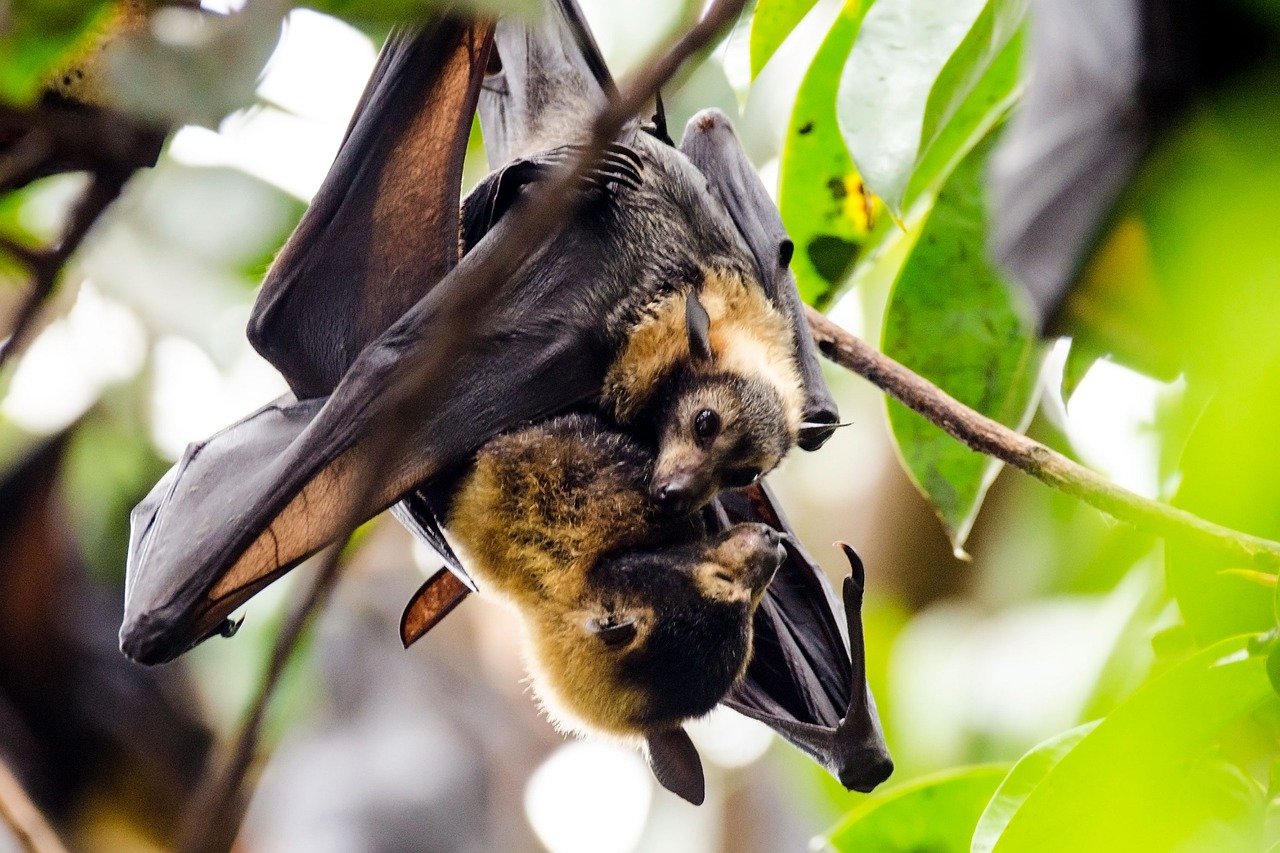
Considering how unusual bats are as our planet’s only truly flying mammal (ever!), the things that bats do in common with other mammals like us can also seem strange. A major one that makes total sense but seems shocking at first is that bat moms nurse their young. Giving birth upside down, their babies, called pups, are able to cling to their bodies and nurse when they need food. Bat moms need lots of good nutrition at that stage in their life cycle, and have to move around to forage for food to get enough calories to produce milk.
Interestingly, in line with their surprisingly long lifespans, bats also have a long gestation period, with some species like vampire bats being pregnant for around seven months! Bat babies are also typically very large compared to the mother, and can weigh over 40% of mom’s body weight at birth. With such big babies, it’s not a huge surprise that bats typically only have 1-2 pups at a time. Another major advantage to having only 1-2 babies is that it’s easy for mom to hold onto her babies with her wings to keep them from falling. That’s right–from birth to nursing care, bat moms do the whole shebang of child rearing while hanging from the ceiling of a roost! In line with mom sheltering her babies with her wings, a female bat’s nipples are also located near her armpits, so the pups can nurse easily while being supported.
18. Bats need your help!
Unfortunately, these important animals are declining in many parts of the world. This could eventually lead to many species going extinct. Among the major threats to bats are:
- Habitat loss due to deforestation
- Global declines in insect prey, making it hard to find food
- Loss of roosting sites like large old trees and caves
- Illegal wildlife trade
- Diseases like the white-nose fungus (Pseudogymnoascus destructans) in North America
With all of these intense threats, bats really need our help! You can help bats in your neighborhood by using wildlife-friendly gardening, planting plant species that support bats, or putting up a bat house.
Exclusive Discount on BatBnB for Gulo in Nature Readers
Thinking of picking up some BatBnB gear? Check out their bat houses and other cute bat-related items. Your purchase gets 15% off and helps support th eblog!
I highly recommend bat houses from BatBnB, which are designed specifically to be safe and useful for bug-munching North American bats.


You can also support bats by donating to organizations that toward conserving the world’s bats. One great option is Bat Conservation International.
Want to learn even more facts about bats?
Check out these great episodes of the Nature Guys Podcast about bats and bat behavior!
Thanks for reading amazing facts about bats!
Do you have a favorite fact about bats? Or did we miss one of your favorite bat facts? Tell us about it using the Contact page or connect with us on Social Media. If you’d like to Support the Blog or would like more Gulo in Nature directly to your inbox, check out our Newsletter. Until next time, get to know your natural world!

Key Takeaways: Bat Facts
- Bats are an ancient lineage of mammals, all descended from a land-dwelling ancestor.
- No bat species suck blood, but a couple of species feed on it. The vast majority are extremely helpful pollinators and pest-controllers!.
- Bats are the only mammals capable of true flight.
- Bat populations are declining in many areas. Putting up bat houses is one easy approach to support them in your area.